Library
business · Chapter 1 · poster
Stakeholders in Business
Chapter 1 – Stakeholders in Business
Loading file…
- stakeholders
- relationships
- conflict
Study notes
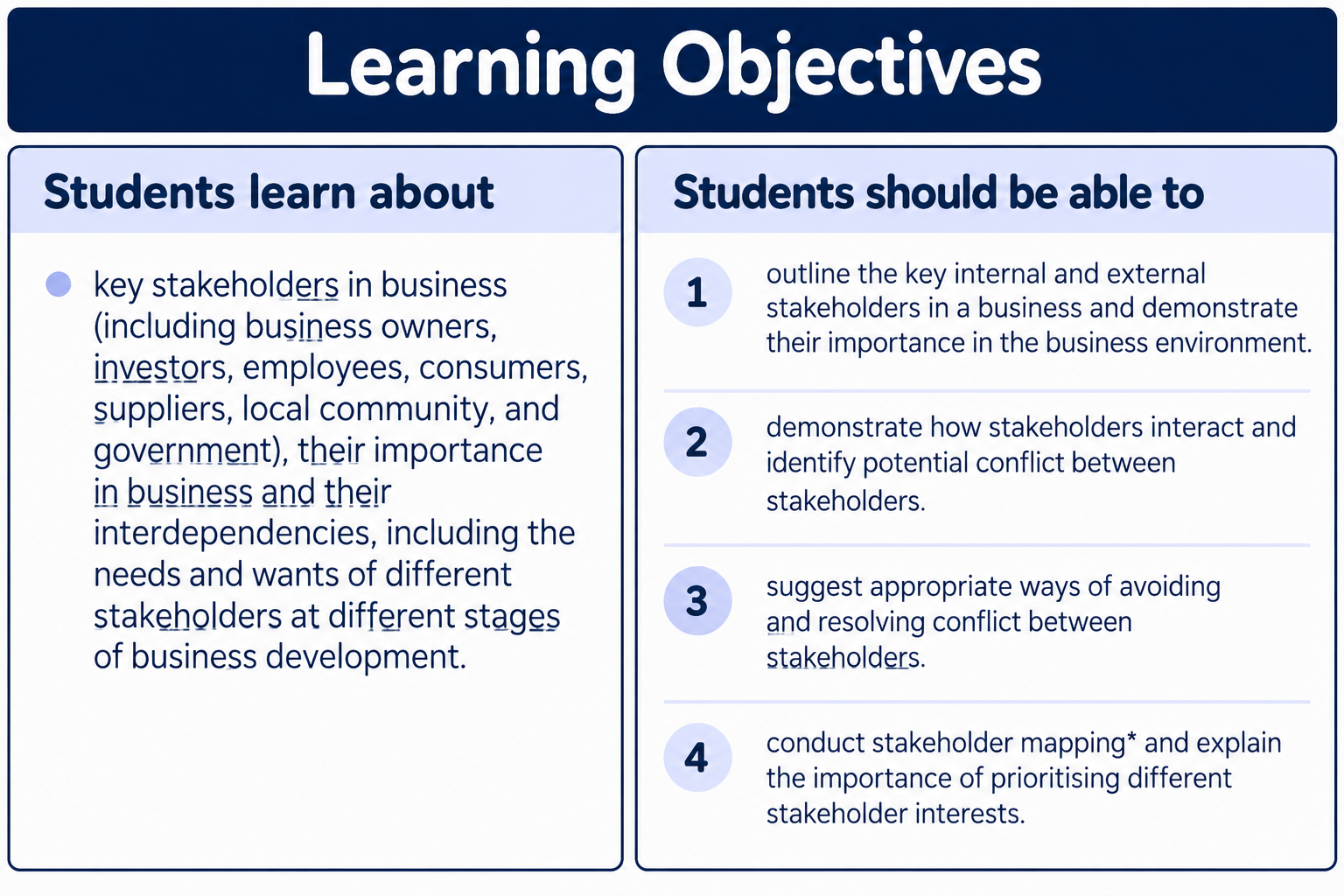
Stakeholders in Business
Introduction
- Businesses rely on many groups of people to operate.
- These groups are called stakeholders.
- Stakeholders can be internal (inside the business) or external (outside but affected by it).
Internal Stakeholders
- Business Owner/Entrepreneur
- Role: Identifies opportunities, takes risks, secures funding, and leads the business.
- Needs/Wants: Profit, recognition, independence, success.
- Example: Shane Curran (Evervault, raised €3m at age 19).
- Managers
- Role: Set objectives, organise resources, motivate staff.
- Needs/Wants: Resources, recognition, career growth.
- Example: Anne O’Leary – Meta Ireland CEO.
- Role: Set objectives, organise resources, motivate staff.
- Employees
- Role: Work daily to produce goods/services, bring skills and ideas.
- Needs/Wants: Fair pay, good conditions, respect, career development.
- Example: Retail assistants in a busy shop.
- Investors
- Role: Provide funding in return for equity (ownership) or debt (loans).
- Needs/Wants: Return on investment, dividends, reduced risk over time.
- Example: Enterprise Ireland or venture capital firms.
External Stakeholders
- Consumers
- Role: Buy goods/services, give feedback, promote brand.
- Needs/Wants: Value for money, quality, ethical/sustainable practices.
- Example: Patagonia customers support its eco-friendly values.
- Local Community
- Role: Provides customers and employees, affected by business presence.
- Needs/Wants: Jobs, services, environmental care.
- Suppliers
- Role: Provide raw materials or services.
- Needs/Wants: Timely payments, long-term contracts.
- Example: McDonald’s uses 100% Irish beef.
- Government
- Role: Regulates businesses, provides grants/training, promotes exports.
- Needs/Wants: Taxes, compliance with laws, job creation, economic growth.
- Interest Groups (Pressure Groups)
- Role: Represent members’ views, lobby government, influence decisions.
- Needs/Wants: Policy changes, ethical standards, favourable conditions.
- Example: Small Firms Association lobbying for cost supports (2024).
Stakeholder Relationships
Cooperative (Win-Win)
- Both parties benefit.
- Examples:
o Employer & Employee → training = skilled staff + better pay chances. o Investor & Business Owner → funding creates profit for both. o Producers cooperating (e.g. cheese festival promotion).
Competitive (Win-Lose)
- One gains, the other loses.
- Examples:
o Employer vs Employee → pay cuts vs pay rises. o Investor vs Manager → dividends vs reinvestment. o Supplier vs Manager → faster payment vs delayed payment.
Conflict Avoidance & Resolution
Avoiding Conflict
- Open Communication (honest feedback, fair complaint handling).
- Corporate Social Responsibility (CSR) (ethical actions, fair pricing).
- Stakeholder Involvement (consulting communities/customers).
Resolving Conflict
- Meet & Talk → direct discussion.
- Negotiation/Bargaining → compromise (e.g. trial work week).
- Mediation → neutral facilitator helps find middle ground.
- Conciliation → third party suggests options, but decision lies with stakeholders.
- Arbitration → independent arbitrator decides, both sides agree to accept outcome.
Stakeholder Mapping
Steps:
- Identify stakeholders (internal & external).
- Analyse their power & interest.
- Place on Power–Interest Grid.
- Allocate resources & communication strategies.
Example – AIB Branch Closures
- Customers (elderly, rural): High interest, low power.
- Local community: High interest, low power.
- Employees: High interest, medium power.
- Government/regulators: High power, high interest.
Importance:
- Improves decision-making by considering all views.
- Helps long-term planning (which stakeholders to prioritise).
- Example: AIB may delay closures after recognising high impact on elderly customers.
Learning objectives