business · notes
AAC – Investigative Study
AAC – Investigative Study
- business alive
- investigative study
- project
- digitalisation
Study notes
What is the Business Alive Investigative Study?
The Business Alive Investigative Study is the project component of Leaving Certificate Business.
- It is worth 200 marks (40%) of your final grade
- The written exam is worth 300 marks (60%)
- It is completed by all Business students (Higher & Ordinary Level)
- It must be your own, individual work
You will complete a research-based report on a real business issue and submit it digitally.
2027 Project Theme
Digitalisation is a major driver of productivity growth through improvements in efficiency and the quality of products and services. Technology is disrupting traditional roles and transforming the world of work.
Your task:
You must investigate how a work practice that uses digital technology impacts either:
- Employers, or
- Employees
You choose a specific focus within this theme (for example: automation, AI, remote working tools, data systems, digital platforms, etc.).
What You Must Produce
You must submit:
- One digital report (PDF format)
- Maximum 1500 words (references, tables, graphs, and images not included)
- Maximum 10 images (properly labelled)
The report must follow the official structure and formatting rules set by the SEC.
Report Structure (Very Important)
Your report must include these headings:
1. Introduction (≈200 words)
- State your research question
- Explain why you chose it
- Refer to your project plan and how you engaged with it
2. Investigation and Findings (≈400 words)
- Explain the research methods used (primary and/or secondary)
- Present findings clearly (tables, graphs where appropriate)
- Show different viewpoints
3. Analysis and Evaluation (≈600 words)
- Analyse what your findings mean
- Evaluate their importance
- Show critical thinking and originality
4. Conclusions (≈300 words)
- Draw conclusions based on your analysis
- Reflect on how your views changed
- Link your findings to the real world of business
5. References
- List all sources used, including websites, reports, interviews, and AI tools
How to Write a High-Quality Business Alive Investigative Study Report
A practical guide to the structure and what the examiner is looking for.
Section 1: Introduction
Suggested word count: Approximately 200 words
What to include
- State your research question.
- Explain the rationale for choosing this question and why it is important to business locally, nationally or internationally.
- Explain why you chose the question.
- Reflect on how you engaged with your project plan and how it helped you complete the study.
What the examiner is looking for
- Demonstrate effective engagement with planning throughout the study.
- Develop a clear and probing research question that is underpinned by the relevance or importance of business locally, nationally and/or internationally.
Section 2: Investigation and Findings
Suggested word count: Approximately 400 words
What to include
- Explain the purpose and relevance of each research method and source used.
- Use a range of reliable, relevant sources and perspectives, such as primary and secondary research.
- Present your research findings in appropriate formats, such as charts, graphs or tables.
- Consider a variety of perspectives.
- Acknowledge supporting references.
What the examiner is looking for
- Identify and evaluate the potential value of a wide range of appropriate sources related to the research question.
- Present clear and appropriate data and information using a range of relevant graphics.
- Clearly acknowledge supporting references.
Section 3: Analysis and Evaluation
Suggested word count: Approximately 600 words
What to include
- Analyse your research findings by breaking them into key points and relationships.
- Compare different sources and perspectives, including areas of disagreement.
- Evaluate the strengths and weaknesses of the evidence.
- Explain what the evidence supports, what it does not support, and why.
- Identify limitations in the research question, design, sources and/or analysis.
What the examiner is looking for
- Complete an in-depth analysis and evaluation of data and information from a range of reliable sources, justifying the choice of sources.
- Clearly identify limitations in the investigative study across the design of the research question, the research gathered and/or analysis conducted.
- Demonstrate originality and critical thinking throughout your analysis and evaluation.
Section 4: Conclusions
Suggested word count: Approximately 300 words
What to include
- Answer the research question using conclusions justified by your analysis.
- Make realistic recommendations supported by your findings.
- Explain how your planning helped you complete the study.
- Reflect on how your perspective changed as a result of the study.
- Connect your findings to the real world of business and relevant themes in the specification.
What the examiner is looking for
- Present conclusions justified by the analysis and evaluation of the data and information related to the research question developed.
- Make recommendations that can be justified as appropriate for the business.
Section 5: References and Appendix
Suggested word count: No word limit
What to include
- Record all sources accurately in the references or bibliography.
- Include relevant supporting material, such as survey questions, interview questions, extra charts, graphs, tables and other research evidence.
- Keep the appendix organised and easy to follow.
Final check before submitting
- Research question: Is it clear?
- Evidence: Is it reliable and referenced?
- Analysis: Does it explain what the findings mean?
- Conclusions: Are your conclusions and recommendations supported by evidence?
High-grade habits
- Plan throughout the study.
- Show different perspectives.
- Use your own critical thinking.
- Communicate clearly and consistently.
- Link your findings to real business practice and the wider world.
Podcast episode: ACE The AAC
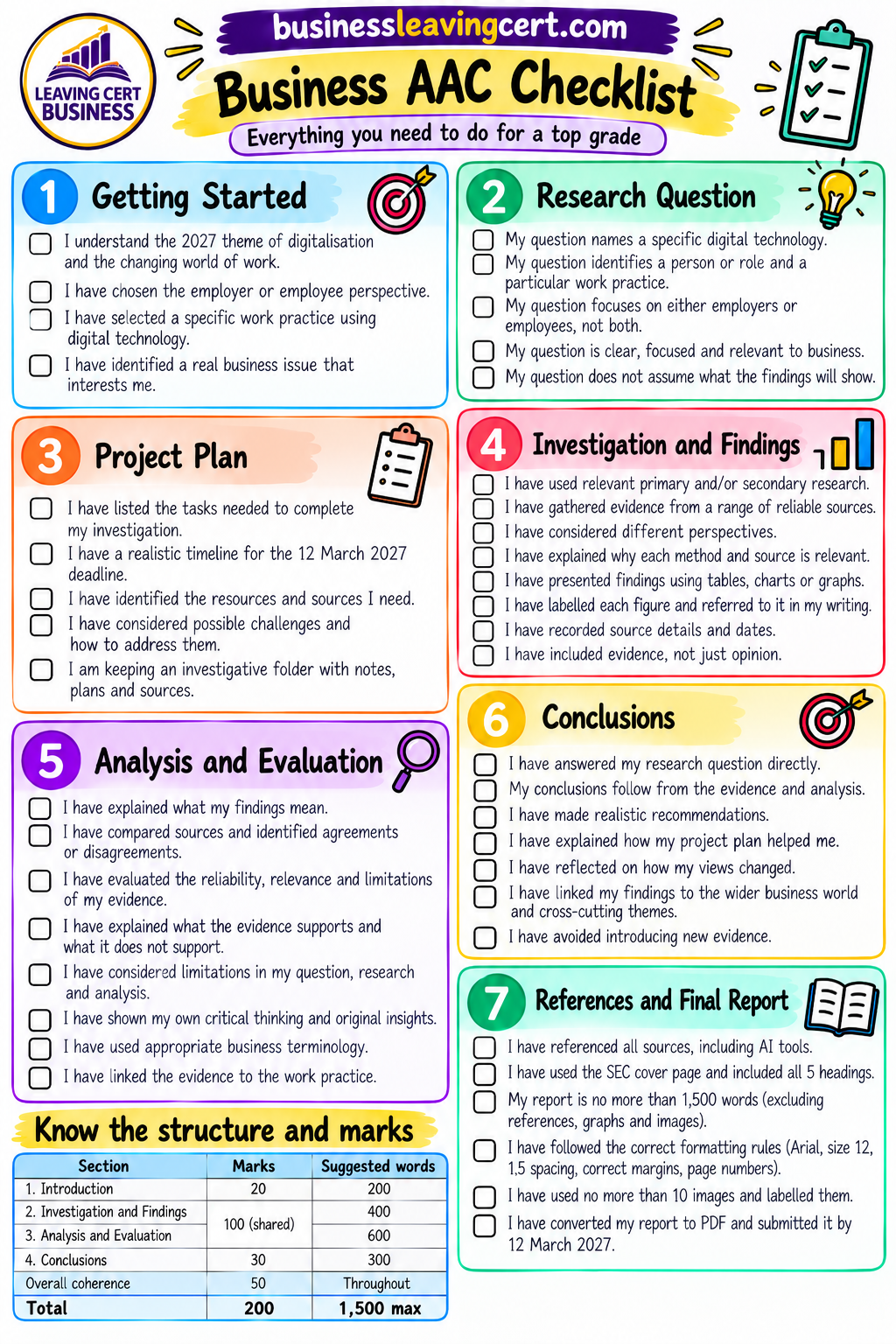
Open in SpotifyBusiness AAC Checklist
Everything you need to do for a top grade — tick it off as you go.