business · Chapter 8 · poster
Business Planning
Chapter 8 – Business Planning
- planning
- business plan
- SWOT
Study notes
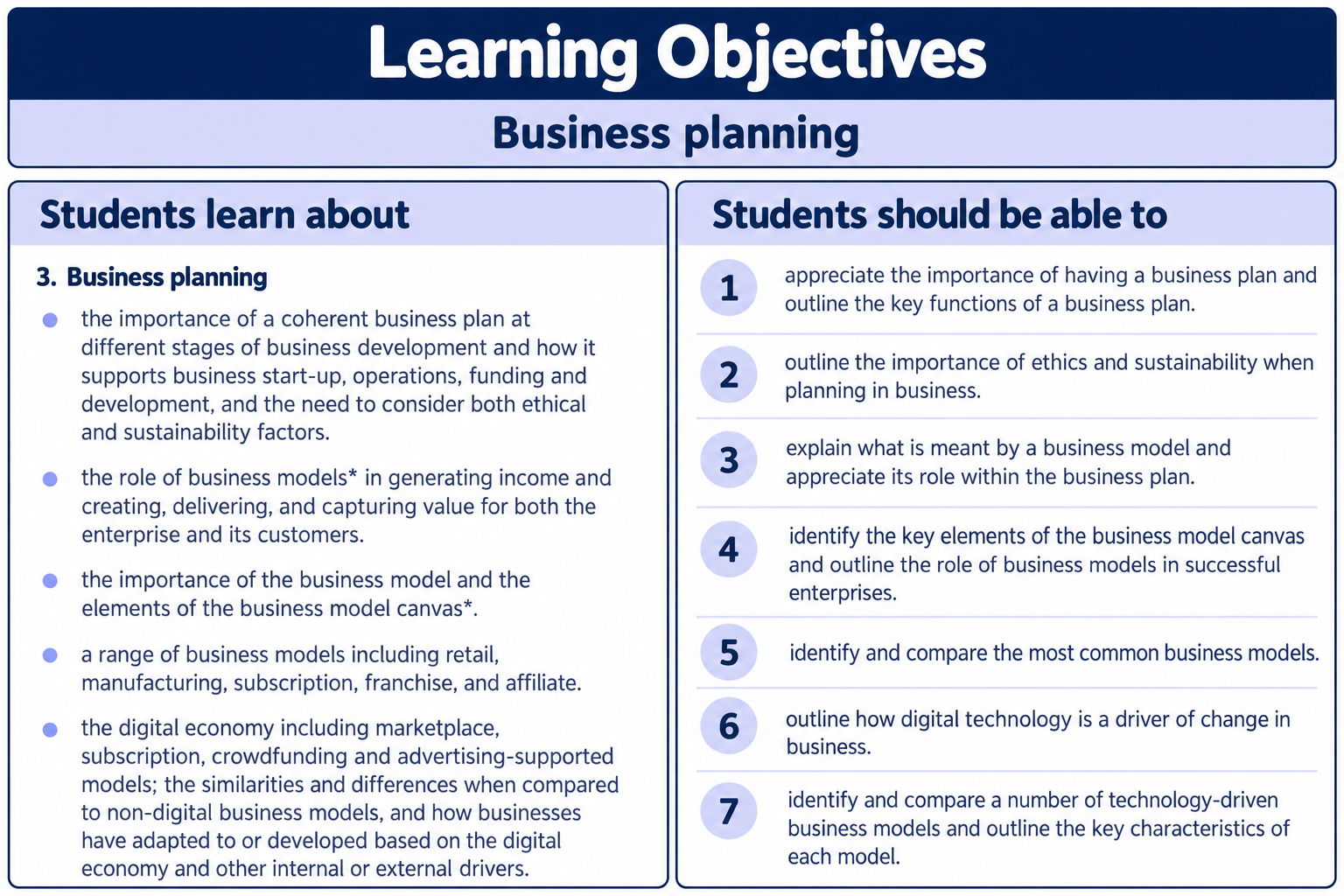
Business Plans
A business plan is a written document that outlines:
- What the business aims to achieve
- How it will achieve it
- What resources it needs
- How success will be measured
It’s essential for clarity, control, and funding.
Key Functions
- Sets goals and strategies – Defines targets and how to achieve them.
- Secures funding – Shows investors or banks that the business is viable.
- Assesses market potential – Analyses demand, target customers, and competitors.
- Identifies risks and challenges – Plans solutions for potential problems.
- Provides a roadmap – Guides operations and decision-making at all stages.
Stages of Importance
| Stage | Purpose | Key Sections |
|---|---|---|
| Start-up | Clarify idea, confirm demand, attract funding | Executive Summary, Market Analysis, BMC, Financial Plan |
| Growth | Guide expansion, manage investment | Sales & Marketing, Financial Plan |
| Maturity | Maintain efficiency and profitability | Operational Plan, Production Plan, Financial Plan |
Main Sections of a Business Plan
- Executive Summary – Overview of goals, market, and finances.
- Market Analysis – Research on target customers and competitors.
- Sales & Marketing Plan – Strategy for attracting and keeping customers.
- Financial Plan – Revenue forecasts, costs, and profit projections.
- Production Plan – How goods or services will be made.
- Operational Plan – Day-to-day running of the business.
- Business Model Canvas – One-page visual summary of the business model.
Ethics and Sustainability in Planning
Why They Matter
- Builds trust and brand loyalty – Customers prefer ethical brands.E.g. Kenco’s “Coffee vs Gangs” campaign.
- Attracts investors and talent – ESG investors favour sustainable firms.
- Avoids legal/reputational risks – Compliance from the start reduces problems.
- Supports long-term profitability – Reduces waste, saves resources.
Examples
- Amazon: Investing in electric vehicles & renewable energy for sustainability.
- Unilever: Reducing plastic use and emissions to attract investors and customers.
- Ben & Jerry’s – Includes social and environmental impact goals in its planning. Supports fair trade ingredients and social justice campaigns, which strengthen its ethical brand image.
- Patagonia – Builds sustainability into every part of its plan. Uses recycled materials, repairs old clothes, and donates 1% of sales to environmental causes. This attracts loyal customers who care about the planet.
What Is a Business Model?
A business model shows how a company creates, delivers, and captures value.
Role within a Business Plan
- Explains how the business operates and makes money.
- Helps stakeholders understand the business’s revenue streams and customer value.
- Keeps the enterprise focused and competitive.
Examples of Models
| Model | Description | Example |
|---|---|---|
| Retail | Buys from suppliers and sells to consumers | Tesco |
| Manufacturing | Produces goods from raw materials | Dell |
| Subscription | Customers pay regularly for ongoing access | Spotify |
| Franchise | Licenses brand and systems to franchisees | Supermac’s |
| Affiliate | Earns commission for promoting products | TikTok influencers for Gymshark |
The Business Model Canvas (BMC)
The Business Model Canvas is a strategic planning tool that gives a clear, one-page overview of how a business creates, delivers, and captures value.It helps entrepreneurs, investors, and managers quickly understand how a business operates and makes money.
It contains 9 key elements, divided into four main areas:
| Area | Elements | Description |
|---|---|---|
| Infrastructure | Key Partners, Key Activities, Key Resources | How the business runs |
| Offering | Value Proposition | What the business offers |
| Customers | Customer Segments, Channels, Customer Relationships | Who the business serves and how |
| Finances | Revenue Streams, Cost Structure | How the business earns and spends money |
Key Partners
These are the external organisations or individuals that help the business operate successfully.They reduce risk, provide resources, or carry out essential activities.
Examples:
- Suppliers (raw materials, ingredients)
- Manufacturers or logistics companies (delivery)
- IT providers or software developers
- Marketing agencies or influencers
- Strategic alliances (e.g. Apple and Foxconn)
Why they matter: Partners allow the business to focus on core strengths while outsourcing specialised tasks.
Key Activities
These are the most important actions a business must do to operate effectively and deliver value.
Examples:
- Production (manufacturing, design, packaging)
- Marketing and sales (advertising campaigns)
- Customer service
- App development (for tech businesses)
- Quality control
Why they matter: They show what the business must do well every day to succeed.
Key Resources
These are the assets the business uses to create and deliver its product or service.
Examples:
- Human – staff skills, management experience
- Physical – buildings, vehicles, equipment
- Intellectual – patents, copyrights, brand name
- Financial – cash reserves, access to credit
Why they matter: Without these, the business cannot create or deliver its value proposition.
Value Proposition
This is the unique benefit or value that makes customers choose the business over competitors.It explains what problem the business solves or what need it satisfies.
Examples:
- Apple: innovative, easy-to-use technology
- All Real Nutrition: Irish-made, plastic-free protein bars
- Vinted: affordable, sustainable fashion
- Ryanair: lowest-cost travel option
Why it matters: It’s the core reason customers buy from you.
Customer Segments
These are the different groups of people or organisations a business serves.Each segment may have different needs, pricing, and communication preferences.
Examples:
- Age groups (teens, adults, seniors)
- Business vs. individual customers
- Premium vs. budget markets
Why they matter: Understanding customer segments ensures products are targeted effectively.
Customer Relationships
This shows how a business interacts with its customers — from first contact to long-term loyalty.
Examples:
- Personalised service (e.g. hair salon)
- Self-service (e.g. online banking)
- Community engagement (e.g. online forums)
- Loyalty schemes (e.g. Tesco Clubcard)
- Customer support (e.g. live chat)
Why they matter: Strong relationships encourage repeat business and brand loyalty.
Channels
Channels describe how products or services reach customers and how communication happens.
Examples:
- Physical stores
- Company website or app
- Social media
- Email newsletters
- Wholesalers or distributors
Why they matter: Channels affect customer convenience and brand visibility.
Revenue Streams
This shows how the business makes money — its sources of income.
Examples:
- Direct sales (shops, e-commerce)
- Subscription fees (Netflix, Spotify)
- Licensing or franchising fees
- Advertising revenue (YouTube, TikTok)
- Commission from sales (Amazon marketplace)
Why they matter: They reveal the sustainability and profitability of the business model.
Cost Structure
These are the major costs the business faces in operating and delivering value.
Examples:
- Rent, utilities, wages
- Marketing and advertising
- Raw materials and inventory
- Technology and maintenance
- Delivery and logistics
Why they matter: Helps determine pricing strategy and profit margins.
Example: Netflix’s Business Model Canvas
| Element | Netflix Example |
|---|---|
| Key Partners | Film studios, internet providers, device manufacturers |
| Key Activities | Content creation, app development, customer support |
| Key Resources | Streaming technology, brand, user data |
| Value Proposition | Unlimited, ad-free entertainment anytime, anywhere |
| Customer Segments | Global audience, different age and interest groups |
| Customer Relationships | Personalised recommendations, easy subscriptions |
| Channels | Website, mobile app, smart TVs |
| Revenue Streams | Monthly subscriptions, premium tiers |
| Cost Structure | Content licensing, production, marketing, server costs |
Comparing Business Models
| Business Model | How Revenue is Generated | How Value is Delivered |
|---|---|---|
| Retail | Selling goods at markup | Convenience, choice, loyalty rewards |
| Manufacturer | Selling products made from raw materials | Innovation, quality, efficiency |
| Subscription | Monthly/annual fees | Continuous access, flexibility |
| Franchise | Franchise fees + royalties | Consistent quality, wide availability |
| Affiliate | Commission on sales via promotion | Trusted recommendations, targeted ads |
Digital Technology as a Driver of Change
Internal Change
- Innovation & Product Development – ASOS uses social media to test designs.
- Efficiency & Automation – Amazon uses AI and robots for inventory.
- Data-Driven Decisions – Netflix uses viewing data to plan shows.
- Employee Collaboration – Slack, Notion, and Trello enable teamwork.
External Change
- Changing Consumer Behaviour – Gymshark uses TikTok for feedback.
- Competitive Pressure – Uber forced taxis to digitise.
- Globalisation – Shein uses digital payments to reach new markets.
- Brand Image & Engagement – Ryanair uses humour on social media.
Technology-Driven Business Models
| Model | Example | Revenue Generation | Access & Cost | Scalability & Growth | Engagement |
|---|---|---|---|---|---|
| Marketplace | Vinted, Airbnb | Fees from transactions | Free/low-cost | Grows as users join | Reviews & ratings build trust |
| Subscription | Netflix, Spotify | Recurring payments | Paid access | Global scale, low cost per user | Personalised recommendations |
| Crowdfunding | GoFundMe, Kickstarter | Public donations | Free to browse | Viral potential | Storytelling builds community |
| Advertising-Supported | YouTube, TikTok | Ads & impressions | Free to use | Extremely scalable | Algorithms drive engagement |
Comparing Tech vs Non-Tech Models
| Traditional | Technology-Driven |
|---|---|
| Physical store hours | 24/7 global access |
| Local customer base | Worldwide reach |
| Slower feedback | Real-time analytics |
| High costs to scale | Low-cost scalability |
| Fixed marketing | Personalised ads & data use |
Learning objectives